Facts About Projection
A short film looking at the life of a film projectionist.
Monday, January 31, 2011

Sunday, January 30, 2011
Saturday, January 29, 2011
Friday, January 28, 2011
Reaction Paper #2 due Feb. 4
First, a video:
http://video.google.com/videoplay?docid=-6483543718966313073&hl=en#
According to the Matt Mason, speaker and author of The Pirate's Dilemma, how is copyright out of touch compared to the way that we are sharing and using information? Also, summarize his three main points: why piracy is important, how it works and how should we respond? What's your analysis of these points?
http://video.google.com/videoplay?docid=-6483543718966313073&hl=en#
According to the Matt Mason, speaker and author of The Pirate's Dilemma, how is copyright out of touch compared to the way that we are sharing and using information? Also, summarize his three main points: why piracy is important, how it works and how should we respond? What's your analysis of these points?
Thursday, January 27, 2011
Remember the cover of Time from 1994 I showed in class? Here is the accompanying article (even though the date says 2005).
What seems most dated about the article?
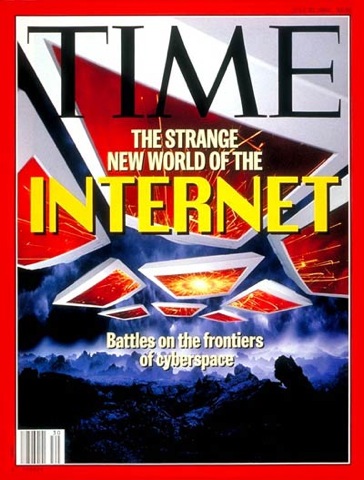
What seems most dated about the article?
Pirate of Silicon Valley - part 1 on YouTube. Great movie... tell me what you think in the comments (maybe you disagree!).
Monday, January 24, 2011
Chapter 2 slides
Should be here soon. I made it a movie because the file was too big to post on Google Docs.
Test #1 due 1-31
Intro to Mass Media
Test I (Take-home)
Rules:
1. Your main source for this test is the book, but you are free to use outside sources or our lecture. Please cite any outside sources at the end of the paper (you can choose the citation style: MLA, APA, etc.)
2. You can use fellow classmates.
3. The test must be written 100% by yourself. That means you can talk about the answers with a classmate, but when you sit down to write it has to be all yours. If it is too similar to another classmate's, I either won't take them or make both students redo it with new questions, depending on how similar they are.
Pick TWO questions to answer.
You should write about 2-3 double spaced pages for each question (4-6 pages total)
Please print and turn in at the start of class Monday, Jan 31.
1. (Chapter 1) Please define and discuss at least four functions of the mass media. What dysfunctions are associated with each function? Use examples if you can.
2. (Chapter 1) What is convergence, and what types of convergence are happening now? Be sure to discuss some of the positive and negative aspects of this phenomenon.
3. (Chapter 1 & 2) What does it mean to be "media literate," and why is it important? What are some key areas of understanding one should have to be considered media literate?
4. (Chapter 2) You are the editor of the campus newspaper. One of your reporters has just written a series of articles describing apparent health-code violations in a popular off-campus restaurant. This particular restaurant regularly buys full-page ads in your paper. After you run the first story in the series, the restaurant owner calls and threatens to cancel all her ads unless you stop printing the series. The ads are a significant part of your paper's budget.
What is the ethical dilemma here? Use the ethical principals on pp. 53-55 to analyze the situation and pick the best course of action.
Friday, January 21, 2011
Reaction Paper #1 due 1-28
Here is the article.
(Let me know if it tries to make you sign in or if you have any problem clicking on the link, sometimes the NY Times has issues)
I'd like you to
1. Summarize the concerns researchers have when it comes to all these digital distractions for kids.
2. Give me your thoughts -- do you tend to agree or think the concerns are overblown?
3. What can/should be done about these digital distractions? If there should be limitations, what age would you lift them?
Length: ~700 words. (At least a page single spaced)
Again, you can print it and hand it in on Friday in class or email it to me by the end of the day (midnight) on Friday 1/28.
Edit: if it is making you register, you can try clearing your browser cache/history.
(Let me know if it tries to make you sign in or if you have any problem clicking on the link, sometimes the NY Times has issues)
I'd like you to
1. Summarize the concerns researchers have when it comes to all these digital distractions for kids.
2. Give me your thoughts -- do you tend to agree or think the concerns are overblown?
3. What can/should be done about these digital distractions? If there should be limitations, what age would you lift them?
Length: ~700 words. (At least a page single spaced)
Again, you can print it and hand it in on Friday in class or email it to me by the end of the day (midnight) on Friday 1/28.
Edit: if it is making you register, you can try clearing your browser cache/history.
Monday, January 17, 2011
pre-Reaction paper due Friday 1-21
Hey folks,
I'll send the first real paper out on Friday the 21st, but in the meantime here is a warm-up paper for me to get to know you guys and what your interests are in the mass media.
Please tell me what your interests are in the mass media: do you enjoy books, the Internet, video games, movies, TV, radio, music, or all of the above? Do you have any favorite websites?
What do you look forward to learning about in the mass media? What don't you look forward to learning about?
Any other concerns, questions, or ideas for me regarding class?
Worth 5 points.
The paper should be about a page single-spaced. You can hand it in Friday or email it to me.
I'll send the first real paper out on Friday the 21st, but in the meantime here is a warm-up paper for me to get to know you guys and what your interests are in the mass media.
Please tell me what your interests are in the mass media: do you enjoy books, the Internet, video games, movies, TV, radio, music, or all of the above? Do you have any favorite websites?
What do you look forward to learning about in the mass media? What don't you look forward to learning about?
Any other concerns, questions, or ideas for me regarding class?
Worth 5 points.
The paper should be about a page single-spaced. You can hand it in Friday or email it to me.
Book summary E.C.
Based on the book you found at the library and brought the second day:
1. Read the book.
2. Write a 700-word summary. What interesting points does the author make? What seems the most relevant to class? Do you disagree with any assertions?
3. Hand it in/email me your paper before March 1st.
Earn up to 10 points extra credit (I know it's early for E.C... but hey, might be smart to take advantage of it).
P.S. you can choose a new book if you grabbed a bland one (or if you didn't get a chance to pick one up originally).
1. Read the book.
2. Write a 700-word summary. What interesting points does the author make? What seems the most relevant to class? Do you disagree with any assertions?
3. Hand it in/email me your paper before March 1st.
Earn up to 10 points extra credit (I know it's early for E.C... but hey, might be smart to take advantage of it).
P.S. you can choose a new book if you grabbed a bland one (or if you didn't get a chance to pick one up originally).
Sunday, January 9, 2011
Intro to Mass Media
JOU 110
Syllabus • Spring 2011
Ankeny Campus
Instructor : Andy Langager
Email: andylangager@gmail.com
Cell phone: 319-290-8229
Office: Building 3W, Room 2 (Office inside on the left)
Office Hours: By appointment
Class website: http://mass-media-class.blogspot.com
This class meets MWF 9:05-10 a.m. • Building 2 Room 13
Course Description:
We have "Freedom of the Press," but have you ever considered what isn't allowed to be printed in the newspaper or broadcast on the radio? Have you thought about how the invention of television impacted the film industry? What about the content of your Facebook profile as a concern when you're applying for a job?
We can't escape the mass media in our daily lives. TV, radio, the Internet, film, music, magazines and books surround us everyday. To be an effective participant in our democratic society, it is essential to be able to think critically about the mass media and understand its history, laws, ethics, and effects.
I want you be engaged with this class: participating in class discussions and reaction papers will challenge your critical thinking, while the tests will demonstrate your understanding of its history, laws, ethics and effects.
Required Text:
Pavlik, John V. and McIntosh, Shawn. Converging Media. Second Ed.
Email: Regular access to email is a strong requirement for this course. Assignments, study guides, and other class info will be sent via email.
Attendance policy: Attendance is an important part of succeeding in this course. Much of what we do will involve class discussion. I do not take regular attendance, but we will have short quizzes from time to time -- points that you can only earn if you are in class.
Reaction Papers: We'll have 10 reaction papers assigned throughout the semester. Each will be worth 10 points. You'll have a week to do them once I send them out. Try not to miss any; the points quickly add up to a large part of your grade.
Papers will be about one full page single spaced, based on a short reading assignment or theme. You can email your paper before class on Fridays or hand it on on paper during class.
Research Paper: We will have a five page research paper on the subject of your choice that will be due toward the end of the semester. More info as we get closer.
Tests: There will be five tests (including the final). We will have two essay tests and three that are multiple choice, true false, short answer and essay.
Academic dishonesty: Cheating and plagiarism will be dealt with according to DMACC's official policies. Always cite your sources, never lift other sentences word for word without using quotes. Attribute any ideas or facts that aren't common knowledge to the original author. If you're not sure, ask for help.
Conferences: Feel free to schedule a conference with me anytime. Email is a great way to reach me; I check it often. I may not be on campus when you are (outside of this class), so scheduling a meeting is the best way to get a hold of me. My office is in Room 2 (The Chronicle room), building 3W in Ankeny.
Grading:
Tests: 5 x 50 points = 250 points total
Reaction papers: 10 papers x 10 points each = 100 points
Research paper: 50 points
Quizzes and participation: 50 points
= 450 total points
Grading scale:
94-100% A
90-93 A-
87-89 B+
84-86 B
80-83 B-
77-79 C+
74-76 C
70-73 C-
67-69 D+
64-66 D
60-63 D-
59 and lower F
"A" work: Deadlines met regularly for assignments; student has gone above and beyond to demonstrate he or she understands the concepts of the assignment. Shows time and effort put into every assignment. Communicates with instructor about missed classes. Overall work is excellent.
"B" work: Deadlines met for nearly every assignment; student has show he or she has a strong understanding of the concepts of the assignments. The basic requirements of the assignments are fulfilled with good, solid work. Overall work is above average.
"C" work: Most deadlines met, but some missed. Not all assignments fulfilled to specifications. Student shows some understanding for the concepts at hand, but some of the work could have benefited from more time or effort put into it. Sometimes communicates with instructor about missed classes. Overall work is average.
"D" work: Deadlines missed regularly. More than one or two assignments missed. Student does not fully demonstrate an understanding of the concepts. Rarely communicates with instructor. Not much effort put into work. Overall work is below average.
"F" work: Deadlines missed regularly. Assignments left incomplete. Student shows distinct lack of effort towards the class. No demonstration of learning the concepts at hand. Almost no communication with instructor. Overall work is far below average.
Staying in touch with the media: Since this class is all about the mass media, I encourage you to stay current, especially with news (whether it be TV, Internet, or radio). Keep in mind anything interesting going on in the media to discuss in class (or email me a link and I'll put it on our class blog!)
Late assignments & Tests
• Reaction papers: will take papers up to 5 days late with no penalty. Papers won't be accepted after 5 days (talk to me if you need an extension on an assignment)
• Tests: You can make up a test for full credit with a note from a doctor (or pre-arrangement with me) otherwise late tests will be marked off 20% (you'll have 7 days to make it up)
• Research paper: 20% off for late papers
Classroom conduct: It goes without saying to treat fellow classmates (as well as your instructor!) with respect.
Yes, I (and your classmates) can see when you are texting. Please turn cell phones to vibrate and leave the class without disruption if you need to make a call, get a drink, etc. Please don't read newspapers, work on other assignments, or have side conversations during class time. Also, please come to class on time.
DMACC websites
Admissions & registration http://www.dmacc.edu/potienti.asp
WebCT http://webct.dmacc.edu/webct/public/home.pl
Student handbook http://www.dmacc.edu/handbook/welcome.asp
Add/drop dates http://www.dmacc.edu/registration/add_drop.asp
Refund policy http://www.dmacc.edu/refund.asp
Library (Building 6 Ankeny) http://www.library.dmacc.edu/
Academic Achievement Center: Building 6. MW 9 a.m. - 4 p.m. / TR 9 a.m. - 6 p.m.
For an appointment call 515-633-2472
Support services
"It is the policy of DMACC to accommodate students with disabilities. Any student with a documented disability who requires reasonable accommodation should contact the special needs coordinator at 515-964-6850 voice or 515-964-6810 TTY." Also, http://www.dmacc.edu/student_services/disabilities.asp
Important: For each reading assignment listed, you should have it completed for the day it is listed.
----------------------------------------------------------------------------
Monday - January 10
Introduction
Wednesday - January 12
Syllabus
Friday - January 14
Part 1: The Changing Media Landscape
Chapter 1 MASS COMMUNICATION AND ITS DIGITAL TRANSFORMATION
----------------------------------------------------------------------------
Monday - January 17 - NO CLASS (MLK Day)
Wednesday - January 19
Chapter 1 continued
Friday - January 21
Chapter 2 MEDIA LITERACY AND THEMES
----------------------------------------------------------------------------
Monday - January 24
Chapter 2 continued
(Take-home Essay Test)
Wednesday - January 26
Part 2: Mass-Communication Formats
Chapter 3 DIGITAL MEDIA: ONLINE AND UBIQUITOUS
Friday - January 28
Chapter 3 continued
----------------------------------------------------------------------------
Monday - January 31
Chapter 4 PRINT MEDIA: BOOKS, NEWSPAPERS, MAGAZINES
Wednesday - February 2
Chapter 4 continued
Friday - February 4
Chapter 5 AUDIO MEDIA: MUSIC RECORDINGS, RADIO
----------------------------------------------------------------------------
Monday - February 7
Chapter 5 continued
Wednesday - February 9
Chapter 6 VISUAL MEDIA: MOVIES AND TELEVISION
Friday - February 11
Chapter 6 continued
----------------------------------------------------------------------------
Monday - February 14
Chapter 6 continued
Wednesday - February 16
In-Class Test (Test #2)
Friday - February 18 - NO CLASS (College closed)
----------------------------------------------------------------------------
Monday - February 21
Part 3 How Digital Media Are Changing Our World
Chapter 7 INFORMATION OVERLOAD, USABILITY, AND INTERACTIVE MEDIA
Wednesday - February 23
Chapter 7 continued
Friday - February 25
Chapter 8 NETWORKS AND DISTRIBUTING DIGIAL CONTENT
----------------------------------------------------------------------------
Monday - February 28
Chapter 8 continued
Wednesday - March 2
Chapter 9 SOCIAL MEDIA AND WEB 2.0
Friday - March 4
Take-home Test (Test #3)
----------------------------------------------------------------------------
Monday - March 7 (Semester halfway point)
Part 4: Media Perspectives
Chapter 10 JOURNALISM
Wednesday - March 9
Chapter 10 continued
Friday - March 11
Chapter 10 continued
----------------------------------------------------------------------------
March 14-20: SPRING BREAK!
----------------------------------------------------------------------------
Monday - March 21
Chapter 11 ENTERTAINMENT
Lecture: Video Games
Wednesday - March 23
Video games, continued
Friday - March 25
Chapter 12 ADVERTISING AND PUBLIC RELATIONS
----------------------------------------------------------------------------
Monday - March 28
Chapter 12 continued
Wednesday - March 30
Chapter 12 continued
Friday - April 1
Test #4
----------------------------------------------------------------------------
Monday - April 4
Part 5: Media and Society
Chapter 13 MEDIA THEORY AND RESEARCH
Wednesday - April 6
Chapter 13 continued
Friday - April 8
Ethics Lecture
----------------------------------------------------------------------------
Monday - April 11
Chapter 14 COMMUNICATION LAW AND REGULATION IN THE DIGITAL AGE
Wednesday - April 13
Chapter 14 continued
Friday - April 15
Chapter 14 continued
----------------------------------------------------------------------------
Monday - April 18
CHAPTER 15 MASS COMMUNICATION AND POLITICS IN THE DIGITAL AGE
Wednesday - April 20
Chapter 15 continued
Friday - April 22
Lecture: The Global Village
----------------------------------------------------------------------------
Monday - April 25
Global Village continued
Wednesday - April 27
Review/make-up day
Friday - April 29
No class
----------------------------------------------------------------------------
Final Exam: Wednesday - May 4 (Chapters 13, 14, 15, Ethics & Global Village Lecture)
9:15 a.m. - 11:15 a.m.
Disclaimer: "This syllabus is representative of materials that will be covered in this class; it is not a contract between the student and the institution. It is subject o change without notice. Any potential exceptions to stated policies and requirements would be addressed on an individual basis, and only for reasons that meet specific requirements. If you have an problems related to this class, please feel free to discuss them with me."
Subscribe to:
Posts (Atom)