Thursday, August 25, 2011

Tuesday, April 19, 2011
Final Reaction Paper due 4-29 (midnight)
Worth up to 20 points..
When a lawyer presents a case to the court, one way of creating a strong argument is citing precedent: past court cases that are similar to yours, where the outcome is in your favor.
Use your best skills of argument and finding past precedent in this paper:
A nuclear power plant located in Colorado Springs, CO. provides power to a 400-mile radius.
The plant is notable for being tied to the Defense Department's local network of "in-case-of-disaster" installations (the North American Aerospace Defense Command is located in Colorado Springs).
A journalist receives a tip from a source whose name they know but wishes to remain anonymous in print (or they won't give the journalist information). The tip concerns the lack of security at the plant, including sleeping guards and visibly broken security cameras.
The plant offers a tour to the public once a month. Of course, no cameras are allowed. The journalist goes undercover, posing as a regular citizen, and takes the tour. Once inside the journalist uses a special hidden camera to take still photographs.
The tipster was right. The journalist discovers many faults in the security at the plant.
The newspaper decides to go with it as a multi-part story, spanning five days. Different pictures and detailed notes from inside will be published.
After the first edition is released, the government immediately springs to action. The Defense Department launches an injunction against the paper, trying to stop further pictures and details from being published whatsoever -- with concerns about security and the information getting into the wrong hands -- and also to reveal the identity of the anonymous source. They also want to charge the journalist with trespassing.
The court will hear the opening arguments to decide if the paper has a right to publish this information and whether the journalist must reveal their source.
Take one side or the other. The side of the newspaper, arguing for the right to print it (and no trespassing), or the side of the Defense Department, arguing that it should not be allowed to go to print (and the journalist should be charged with trespassing).
**** Your best bet to win is to cite prior court cases that show that you are right. **** You can use court cases from your book (Chapter 14) or from the Internet (one idea, try Googling: reporter trespassing).
When a lawyer presents a case to the court, one way of creating a strong argument is citing precedent: past court cases that are similar to yours, where the outcome is in your favor.
Use your best skills of argument and finding past precedent in this paper:
A nuclear power plant located in Colorado Springs, CO. provides power to a 400-mile radius.
The plant is notable for being tied to the Defense Department's local network of "in-case-of-disaster" installations (the North American Aerospace Defense Command is located in Colorado Springs).
A journalist receives a tip from a source whose name they know but wishes to remain anonymous in print (or they won't give the journalist information). The tip concerns the lack of security at the plant, including sleeping guards and visibly broken security cameras.
The plant offers a tour to the public once a month. Of course, no cameras are allowed. The journalist goes undercover, posing as a regular citizen, and takes the tour. Once inside the journalist uses a special hidden camera to take still photographs.
The tipster was right. The journalist discovers many faults in the security at the plant.
The newspaper decides to go with it as a multi-part story, spanning five days. Different pictures and detailed notes from inside will be published.
After the first edition is released, the government immediately springs to action. The Defense Department launches an injunction against the paper, trying to stop further pictures and details from being published whatsoever -- with concerns about security and the information getting into the wrong hands -- and also to reveal the identity of the anonymous source. They also want to charge the journalist with trespassing.
The court will hear the opening arguments to decide if the paper has a right to publish this information and whether the journalist must reveal their source.
Take one side or the other. The side of the newspaper, arguing for the right to print it (and no trespassing), or the side of the Defense Department, arguing that it should not be allowed to go to print (and the journalist should be charged with trespassing).
**** Your best bet to win is to cite prior court cases that show that you are right. **** You can use court cases from your book (Chapter 14) or from the Internet (one idea, try Googling: reporter trespassing).
Final Study Guide
It's a lot of stuff! We'll do a review on the last day of class -- either Wednesday or Friday next week. If we get ahead of schedule we can review Wednesday and have Friday as a day off to finish the last reaction paper and study for the test.
If you don't recognize a term from your notes, lecture, or the book, you can search Google or ask me!
Chapter 13 & lecture
Qualitative vs Quantitative research
Magic bullet theory
Minimalist effects theory (with two-step flow)
Media Research - survey's, experiments, panel studies - pro's and con's of each
Socialization
Narcotizing theory
Spiral of Silence
Third person effect
Cultivation/Gerbner
Stereotypes (with cultivation theory)
How has the Internet changed politics?
Bandura and Bobo doll research
Different approaches to violence in the mass media
Violence: Catharsis/Stimulation/Catalytic theories
Social effects of the Internet?
Agenda setting
Mainstreaming, resonance
Children and Advertising
Chapter 14 & lecture
First Amendment.. what are the five freedoms
What is Prior Restraint
Near vs. Minnesota case.. what did it conclude
Pentagon Papers and prior restraint
Shield laws protect reporters in cases of…?
Freedom of Information Act
Libel, slander, actual malice, NY Times v. Sullivan
Copyright & fair use
Food Lion case.. what was the ruling
Equal Time Rule
The FCC and its evolution
Fairness Doctrine
Does the FCC govern cable and broadcast TV the same way?
Telecommunications Act of 1996
Children's Television Act
Obscenity
Deceptive Advertising is monitored by whom?
Ethics lecture
How journalists make their decisions: Ethical Principles (know basic differences)
Chapter 15 & Global village lecture
Theories of the press (authoritarian, libertarian, social responsibility, developmental, communist) -- which is the U.S.?
Pros and Cons of Outsourcing
Digital divide - 4 main areas (economic equality, social mobility, democracy, economic growth)
What is Al Jazeera?
Role of media in elections
Polling, advertising, debates
Roll of Internet in politics
Push Poll
3 possible essays (I'll give all 3 as an option) -- remember, when you write your essay, err on the site of presenting more information than you think you might need -- show me that you know what you are talking about, not just simply answering the basic premise of the question. This could come down to giving examples, defining terms, or giving historical context.
1. What is the difference between indecent speech and obscenity, and how does the FCC regulate each?
2. Please describe how a media researcher would describe violence in the media and its effect on viewers according to these theories: socialization theory, catharsis theory, stimulation theory, and agenda setting theory.
3. Discuss the role of the mass media in our democracy. What are some of its positive and negative effects on the process, and how is the Internet changing things?
If you don't recognize a term from your notes, lecture, or the book, you can search Google or ask me!
Chapter 13 & lecture
Qualitative vs Quantitative research
Magic bullet theory
Minimalist effects theory (with two-step flow)
Media Research - survey's, experiments, panel studies - pro's and con's of each
Socialization
Narcotizing theory
Spiral of Silence
Third person effect
Cultivation/Gerbner
Stereotypes (with cultivation theory)
How has the Internet changed politics?
Bandura and Bobo doll research
Different approaches to violence in the mass media
Violence: Catharsis/Stimulation/Catalytic theories
Social effects of the Internet?
Agenda setting
Mainstreaming, resonance
Children and Advertising
Chapter 14 & lecture
First Amendment.. what are the five freedoms
What is Prior Restraint
Near vs. Minnesota case.. what did it conclude
Pentagon Papers and prior restraint
Shield laws protect reporters in cases of…?
Freedom of Information Act
Libel, slander, actual malice, NY Times v. Sullivan
Copyright & fair use
Food Lion case.. what was the ruling
Equal Time Rule
The FCC and its evolution
Fairness Doctrine
Does the FCC govern cable and broadcast TV the same way?
Telecommunications Act of 1996
Children's Television Act
Obscenity
Deceptive Advertising is monitored by whom?
Ethics lecture
How journalists make their decisions: Ethical Principles (know basic differences)
Chapter 15 & Global village lecture
Theories of the press (authoritarian, libertarian, social responsibility, developmental, communist) -- which is the U.S.?
Pros and Cons of Outsourcing
Digital divide - 4 main areas (economic equality, social mobility, democracy, economic growth)
What is Al Jazeera?
Role of media in elections
Polling, advertising, debates
Roll of Internet in politics
Push Poll
3 possible essays (I'll give all 3 as an option) -- remember, when you write your essay, err on the site of presenting more information than you think you might need -- show me that you know what you are talking about, not just simply answering the basic premise of the question. This could come down to giving examples, defining terms, or giving historical context.
1. What is the difference between indecent speech and obscenity, and how does the FCC regulate each?
2. Please describe how a media researcher would describe violence in the media and its effect on viewers according to these theories: socialization theory, catharsis theory, stimulation theory, and agenda setting theory.
3. Discuss the role of the mass media in our democracy. What are some of its positive and negative effects on the process, and how is the Internet changing things?
Thursday, April 14, 2011
It's Friday, Friday
Couple notes... no class Friday but we do have Reaction paper #9 due.
Hopefully you're also working on your research paper. If you're having trouble finding good sources, let me know.
But for our online exercise (instead of class) I thought it might be fun to play with YouTube Time Machine.
Click on the link and watch some videos from your birth year. Link to a good one (or a couple) in the comments. Does it seem... "old"? What surprises you about it? How does it differ (if at all) from what we see on TV now?
Hopefully you're also working on your research paper. If you're having trouble finding good sources, let me know.
But for our online exercise (instead of class) I thought it might be fun to play with YouTube Time Machine.
Click on the link and watch some videos from your birth year. Link to a good one (or a couple) in the comments. Does it seem... "old"? What surprises you about it? How does it differ (if at all) from what we see on TV now?
Wednesday, April 6, 2011
Monday, April 4, 2011
Reaction Paper #9 due 4/15
(2nd to last!)
For this paper, I'd like you to come up with a hypothesis or theory about how we interact with the mass media or how the mass media affects us and how you would test it (experiment, survey, focus group, case study, etc.)
For example:
My hypothesis is that students who use Facebook for more than 2 hours a day will have lower grades than those who don't use Facbeook.
In my paper I would explain why I think this is so, then I would explain how I would use a survey to measure this. Go into as much detail as you can when you talk about your study.
Also explain any other factors that might affect the outcome (for example, those without access to a computer wouldn't use Facebook at all, but their grades might be lower because of less computer access, etc). There might be quite a few.
That said, please don't use Facebook in your experiment. :-)
Use these sites to help you decide on a qualitative study (case study, ethnography, etc.) or a quantitative study (survey, experiment, etc).
Qualitative vs Quantitative
Quantitative methods
Qualitative research
Types of Research Designs
Write a couple paragraphs explaining (based on the above links) why the study approach you picked is appropriate and why others might not be.
Remember, you don't have to do the experiment/case study/etc. only explain how you would do it.
For this paper, I'd like you to come up with a hypothesis or theory about how we interact with the mass media or how the mass media affects us and how you would test it (experiment, survey, focus group, case study, etc.)
For example:
My hypothesis is that students who use Facebook for more than 2 hours a day will have lower grades than those who don't use Facbeook.
In my paper I would explain why I think this is so, then I would explain how I would use a survey to measure this. Go into as much detail as you can when you talk about your study.
Also explain any other factors that might affect the outcome (for example, those without access to a computer wouldn't use Facebook at all, but their grades might be lower because of less computer access, etc). There might be quite a few.
That said, please don't use Facebook in your experiment. :-)
Use these sites to help you decide on a qualitative study (case study, ethnography, etc.) or a quantitative study (survey, experiment, etc).
Qualitative vs Quantitative
Quantitative methods
Qualitative research
Types of Research Designs
Write a couple paragraphs explaining (based on the above links) why the study approach you picked is appropriate and why others might not be.
Remember, you don't have to do the experiment/case study/etc. only explain how you would do it.
Here's the Shigeru Miyamoto profile I was talking about. Good read even if the writer doesn't seem to have a great knowledge of video games.
Thursday, March 31, 2011
Test #4 Due Monday 4/11 (midnight)
Same rules as the previous -- open everything, must be written by you.
Remember to cite your sources!
DUE: Monday, April 11 (midnight)
LENGTH: About three double spaced pages per question.
Questions (pick 2)
1. (Chapter 10) Choose and discuss what you believe are the top four most important or influential events in the history of American journalism. Explain why you believe each event is important and what effect it has had on journalism and our culture.
2. (Chapter 11) Pick two forms of entertainment described in Chapter 11 that have been affected by the Internet is different ways. Describe, in as much detail as possible, how they have been affected by the Internet. Where appropriate, try to find facts that will show how revenue was affected. For example, a quick search for music industry revenue finds this useful link.
You can discuss the economic, social/cultural, and/or technological impact of each.
3. (Chapter 12) Pretend you have to explain to a friend the difference between advertising, public relations, and propaganda. How are they similar and different, why some are important to business, and what techniques are used for each? Examples?
Remember to cite your sources!
DUE: Monday, April 11 (midnight)
LENGTH: About three double spaced pages per question.
Questions (pick 2)
1. (Chapter 10) Choose and discuss what you believe are the top four most important or influential events in the history of American journalism. Explain why you believe each event is important and what effect it has had on journalism and our culture.
2. (Chapter 11) Pick two forms of entertainment described in Chapter 11 that have been affected by the Internet is different ways. Describe, in as much detail as possible, how they have been affected by the Internet. Where appropriate, try to find facts that will show how revenue was affected. For example, a quick search for music industry revenue finds this useful link.
You can discuss the economic, social/cultural, and/or technological impact of each.
3. (Chapter 12) Pretend you have to explain to a friend the difference between advertising, public relations, and propaganda. How are they similar and different, why some are important to business, and what techniques are used for each? Examples?
Sunday, March 27, 2011
Reaction paper #8 due Monday April 4
Here is the video (it's 4 parts..if it doesn't work in Chrome, try Firefox or Safari... it starts 30 seconds in)
Part 2
Part 3
Part 4
It's called Killing Us Softly. It has to do with how women are portrayed in advertising. (It does have some adult language and images)
I'd simply like you to:
1. Summarize the the problem the presenter identifies. Do you agree with the presenter, or are the problems exaggerated?
2. What are the effects on women & girls (and boys)?
3. Does the speaker bring up any points you hadn't noticed or thought about before? Why do you think this was?
4. What is your response? What should be done, if anything?
Part 2
Part 3
Part 4
It's called Killing Us Softly. It has to do with how women are portrayed in advertising. (It does have some adult language and images)
I'd simply like you to:
1. Summarize the the problem the presenter identifies. Do you agree with the presenter, or are the problems exaggerated?
2. What are the effects on women & girls (and boys)?
3. Does the speaker bring up any points you hadn't noticed or thought about before? Why do you think this was?
4. What is your response? What should be done, if anything?
Wednesday, March 23, 2011
Tuesday, March 22, 2011
Saturday, March 19, 2011
The new New York Times digital subscription model... what do you think about it?
Pricing here.
A conversation about it on Metafilter.
If you want to write a page about this and the idea of charging for news online (sample ideas: will it work? how else can news organizations make money? is advertising the only other option? would it work with the Des Moines Register? how much would you pay for your favorite news site?), 10 points E.C.
Pricing here.
A conversation about it on Metafilter.
If you want to write a page about this and the idea of charging for news online (sample ideas: will it work? how else can news organizations make money? is advertising the only other option? would it work with the Des Moines Register? how much would you pay for your favorite news site?), 10 points E.C.
Friday, March 18, 2011
Reaction Paper #7 due 3/25 midnight
For reaction paper 7, I'd like you to write a review. It can be a review for a TV show, movie, album, video game or book.
Pretend you are writing for The Campus Chronicle. Your audience is DMACC students. You want to keep your writing somewhat formal, but it doesn't have to be too stiff. Be sure to proofread. Here are some good tips on how to write it. Please read:
http://www.howtodothings.com/hobbies/a2206-how-to-write-a-movie-review.html
It will help if you review something that you are passionate about -- whether you love it or hate it.
Here are some readings for inspiration.
Roger Ebert hates the movie "North"
But he likes Pulp Fiction
Indiana Jones
Mario Kart Wii Review
Remember to be as specific as possible. Don't just say "it had good acting." What made the acting good? What made the story interesting? What made the action scenes boring?
Pretend you are writing for The Campus Chronicle. Your audience is DMACC students. You want to keep your writing somewhat formal, but it doesn't have to be too stiff. Be sure to proofread. Here are some good tips on how to write it. Please read:
http://www.howtodothings.com/hobbies/a2206-how-to-write-a-movie-review.html
It will help if you review something that you are passionate about -- whether you love it or hate it.
Here are some readings for inspiration.
Roger Ebert hates the movie "North"
But he likes Pulp Fiction
Indiana Jones
Mario Kart Wii Review
Remember to be as specific as possible. Don't just say "it had good acting." What made the acting good? What made the story interesting? What made the action scenes boring?
Tuesday, March 15, 2011
Saturday, March 12, 2011
Here's sort of an interesting case where a jury concluded that a blogger had to pay damages because he helped get someone fired. The article could be a little more well-written, though, it doesn't explain very well why it wasn't libel/defamation (like one of the sources claims).
It's relatively rare for me to see a blogger held accountable for defamation and it raises some free speech issues.
It's relatively rare for me to see a blogger held accountable for defamation and it raises some free speech issues.
Friday, March 11, 2011
An interesting note on why Apple has movie trailers on its site. I remember the Phantom Menace trailer being a big deal.
Thursday, March 10, 2011
Sunday, March 6, 2011
Next paper
In case you were wondering we won't have a reaction paper this week.. keep working on the take-home test and we'll start in on reaction papers after spring break!
Wednesday, March 2, 2011
Test #3 (Take-home)
Essay test again... reminder: No Class Friday March 11. It will be a work day for the test (hopefully you can get started before then though), and it will be due (via email this time) by midnight that day.
(I will email you a reply when I get the test... 10 points off if it's late)
You can use your book or any other resource. If you want to use a source besides our book, please cite it at the end of your paper. (MLA Citation examples)
To avoid the appearance of plagiarism, if you use any direct quotes word for word, be sure to put it in quotes and attribute it to the original author.
Here are the questions..... pick two. Write about 2-4 double spaced pages per answer, please.
1. Compare the relationship between television and film in the 1940s and 50s (when TV was still young) to the relationship between television, film, and the Internet today. For example, where is there competition and where is there cooperation, and how do film and/or television try to set themselves apart from the competition (back then and today)?
2. Describe three major milestones (or notable figures) in the history of film and describe some of the impact these milestones had as the film industry evolved.
3. Describe Hollywood's Star System in the golden age of the film industry.
4. Summarize the difference between broadcast, cable, and satellite television. For example, the technology involved, when and how each was introduced, and how each is regulated (or not) by the FCC.
5. Discuss the recent sale of NBC to Comcast. What were some of the stipulations of the sale, and why does the sale itself worry some people?
(I will email you a reply when I get the test... 10 points off if it's late)
You can use your book or any other resource. If you want to use a source besides our book, please cite it at the end of your paper. (MLA Citation examples)
To avoid the appearance of plagiarism, if you use any direct quotes word for word, be sure to put it in quotes and attribute it to the original author.
Here are the questions..... pick two. Write about 2-4 double spaced pages per answer, please.
1. Compare the relationship between television and film in the 1940s and 50s (when TV was still young) to the relationship between television, film, and the Internet today. For example, where is there competition and where is there cooperation, and how do film and/or television try to set themselves apart from the competition (back then and today)?
2. Describe three major milestones (or notable figures) in the history of film and describe some of the impact these milestones had as the film industry evolved.
3. Describe Hollywood's Star System in the golden age of the film industry.
4. Summarize the difference between broadcast, cable, and satellite television. For example, the technology involved, when and how each was introduced, and how each is regulated (or not) by the FCC.
5. Discuss the recent sale of NBC to Comcast. What were some of the stipulations of the sale, and why does the sale itself worry some people?
Saturday, February 26, 2011
Reaction Paper #6 due 3-4
Note: you can either do this one or one of the two from last week (video game or advertisements).
Ok, here is the video. Growing Up Online.
It's a bit long, but good. If you'd rather read, here are the relevant interviews.
Please discuss the issues raised in the video -- parental control over the Internet, digital tools in education, cyber-bullying, suicide, social networks and eating disorders. You don't have to touch on all of them -- but whichever strike a chord with you. Reference the video or interviews.
In the case of some of the problems -- what can be done? What should parents be doing? Is the Internet actually increasing teen suicide and eating disorders, or just creating an alternative outlet for people who would seek it even if the Internet didn't exist?
Bonus: Look up the rates of eating disorders and teen suicides and compare pre-Internet years and post-Internet years (of course there could be a lot more factors than just the Internet).
Ok, here is the video. Growing Up Online.
It's a bit long, but good. If you'd rather read, here are the relevant interviews.
Please discuss the issues raised in the video -- parental control over the Internet, digital tools in education, cyber-bullying, suicide, social networks and eating disorders. You don't have to touch on all of them -- but whichever strike a chord with you. Reference the video or interviews.
In the case of some of the problems -- what can be done? What should parents be doing? Is the Internet actually increasing teen suicide and eating disorders, or just creating an alternative outlet for people who would seek it even if the Internet didn't exist?
Bonus: Look up the rates of eating disorders and teen suicides and compare pre-Internet years and post-Internet years (of course there could be a lot more factors than just the Internet).
Thursday, February 24, 2011
Alternate Reaction Paper #5
You can use this if the video game download doesn't work.... or you can use it for Reaction Paper #6 after the video game paper if it sounds fun. We'll make it due Monday 2-28.
Visit this site that lists (according to them) the 100 Greatest Commercials.
Find 5 of them on YouTube and do a mini-review (a couple paragraphs) for each. What works with the commercial? Does it stand the test of time? Had you seen it before? How would you critique it?
Research Paper Info
Hey folks,
Here is some information about your research paper due Monday, April 25.
It's worth 50 points.
Shoot for about 1200 words (5-7 pages).
Pick a topic in the mass media that you are interested in.
It could be relating to a TV show, band, album, website, radio show, movie, video game, etc. It could also be a media law or a subject like photojournalism ethics (more examples down below).
Give me a history of your subject. Tell me why it matters. Put it in some historical context -- what came before it, what it compares to now, and what might came after it (or might come after it in in the future). Tell me something I don't know.
For example, you might pick to write about the show 24.
You might start off with a short history of the show and how it came to be. Tell me how many people watched it each week. Why is it so popular? What do critics say about it?
Then you could focus on what the show is known for: its portrayal of torture. How is it portrayed? As something good or bad? Has the way 24 shown torture influenced America's perception of torture? Not just what you think, but use evidence from any studies you can find.
You might finish by talking about how the show ended and its legacy.
There you have it. Leave out personal opinion. and let research do the talking. Stay away from first person.
No: "I think the movie is great!" or "Everyone I know is on Facebook."
Yes: "Movie critic Roger Ebert gave the movie four stars, saying....." or "According to Time magazine, 73% of Americans are on Facebook."
Remember, no Wikipedia! You can use it as a starting point and use the sources listed, but not Wikipedia itself.
Finally, remember to cite all the sources you use. You can cite your sources in your papers at the end, but also throughout, like this:
The New York Times states that "24" has 21 million viewers.
or
"24" has 21 million viewers (NY Times, 2005).
Use an APA or MLA style works cited page at the end. If it's not properly formatted, automatic 5 points off, if it's missing altogether, 10 points off (or I might ask you to write one and give it to me if I can't figure out what your sources are). Use this:
Citation machine!
Or this:
MLA Style Guide
Don't be afraid to venture to the library.
Let me know if you have any questions or if I can help brainstorm ideas for your subject.
Here are some ideas:
Social media used by sports teams
Facebook's role in the Middle East revolutions
Has "24" affected our views on torture?
How has the mass media changed after 9/11?
Subliminal advertising
Video game addiction
Video game cultures
Rap (or heavy metal or whatever) and its place in our culture
The many methods of advertising in MTV (music videos, commercials, product placement)
YouTube.. will it ever be profitable?
How the Internet has affected the music industry
Pirating music/software online
Colbert Report vs O'Reilly Factor
Can bands bypass record companies and be successful?
Influence of particular film director (or music producer)
Telecommunications Act of 1996
The FCC's influence on radio or broadcast
Philo Farnsworth .. inventor of the TV
How has the media covered the Iraq war?
How the media has changed the way it has covered war (you could compare Vietnam and Iraq)
Propaganda (especially the Nazi's Triumph of the Will)
Advertising and the Internet
History of the Internet
KDKA - the first radio station
Orson Welles
Is there a liberal bias in the media?
Compare MSNBC or CNN to Fox News
How media in another country compares to the U.S.
Apple vs. Microsoft
Analyze a particular advertising campaign
Ethics - photojournalism, news, advertising, etc.
Censorship of the Internet in China
History and affect of YouTube
Blogging... can you make money doing it?
"The Mickey Mouse" copyright extension act of 1998
Cyber-bullying
Here is some information about your research paper due Monday, April 25.
It's worth 50 points.
Shoot for about 1200 words (5-7 pages).
Pick a topic in the mass media that you are interested in.
It could be relating to a TV show, band, album, website, radio show, movie, video game, etc. It could also be a media law or a subject like photojournalism ethics (more examples down below).
Give me a history of your subject. Tell me why it matters. Put it in some historical context -- what came before it, what it compares to now, and what might came after it (or might come after it in in the future). Tell me something I don't know.
For example, you might pick to write about the show 24.
You might start off with a short history of the show and how it came to be. Tell me how many people watched it each week. Why is it so popular? What do critics say about it?
Then you could focus on what the show is known for: its portrayal of torture. How is it portrayed? As something good or bad? Has the way 24 shown torture influenced America's perception of torture? Not just what you think, but use evidence from any studies you can find.
You might finish by talking about how the show ended and its legacy.
There you have it. Leave out personal opinion. and let research do the talking. Stay away from first person.
No: "I think the movie is great!" or "Everyone I know is on Facebook."
Yes: "Movie critic Roger Ebert gave the movie four stars, saying....." or "According to Time magazine, 73% of Americans are on Facebook."
Remember, no Wikipedia! You can use it as a starting point and use the sources listed, but not Wikipedia itself.
Finally, remember to cite all the sources you use. You can cite your sources in your papers at the end, but also throughout, like this:
The New York Times states that "24" has 21 million viewers.
or
"24" has 21 million viewers (NY Times, 2005).
Use an APA or MLA style works cited page at the end. If it's not properly formatted, automatic 5 points off, if it's missing altogether, 10 points off (or I might ask you to write one and give it to me if I can't figure out what your sources are). Use this:
Citation machine!
Or this:
MLA Style Guide
Don't be afraid to venture to the library.
Let me know if you have any questions or if I can help brainstorm ideas for your subject.
Here are some ideas:
Social media used by sports teams
Facebook's role in the Middle East revolutions
Has "24" affected our views on torture?
How has the mass media changed after 9/11?
Subliminal advertising
Video game addiction
Video game cultures
Rap (or heavy metal or whatever) and its place in our culture
The many methods of advertising in MTV (music videos, commercials, product placement)
YouTube.. will it ever be profitable?
How the Internet has affected the music industry
Pirating music/software online
Colbert Report vs O'Reilly Factor
Can bands bypass record companies and be successful?
Influence of particular film director (or music producer)
Telecommunications Act of 1996
The FCC's influence on radio or broadcast
Philo Farnsworth .. inventor of the TV
How has the media covered the Iraq war?
How the media has changed the way it has covered war (you could compare Vietnam and Iraq)
Propaganda (especially the Nazi's Triumph of the Will)
Advertising and the Internet
History of the Internet
KDKA - the first radio station
Orson Welles
Is there a liberal bias in the media?
Compare MSNBC or CNN to Fox News
How media in another country compares to the U.S.
Apple vs. Microsoft
Analyze a particular advertising campaign
Ethics - photojournalism, news, advertising, etc.
Censorship of the Internet in China
History and affect of YouTube
Blogging... can you make money doing it?
"The Mickey Mouse" copyright extension act of 1998
Cyber-bullying
Monday, February 21, 2011
Sunday, February 20, 2011
So, with all these tablets coming out, why can't companies like Samsung or Motorola beat the iPad's price?
This article talks about how Apple can keep their prices "competitive" (even though when people think of Apple, they think... expensive!)
This article talks about how Apple can keep their prices "competitive" (even though when people think of Apple, they think... expensive!)
Friday, February 18, 2011
Reaction Paper #5 due 2-25
This one involves playing a video game. Here is the page:
http://hcsoftware.sourceforge.net/passage/
Go to the "downloads" and you can get it for Mac or Windows.
Note: if you're on Windows and it's not working, you might have to adjust your security settings.
AFTER you play the game (it takes 5 minutes or so), write a response and reaction of what you think the game means (or what it means to you). (Think about the title, too)
Ok, now wait until you've written your interpretation. Now move on..
Read this statement by the maker:
http://hcsoftware.sourceforge.net/passage/statement.html
...how does this compare to what you thought the game was about? Was there an emotional response for you? If so, how can something so simple draw an emotional reaction? Do video games have as much potential for an emotional story as movies? If movies are considered art, what about video games?
http://hcsoftware.sourceforge.net/passage/
Go to the "downloads" and you can get it for Mac or Windows.
Note: if you're on Windows and it's not working, you might have to adjust your security settings.
AFTER you play the game (it takes 5 minutes or so), write a response and reaction of what you think the game means (or what it means to you). (Think about the title, too)
Ok, now wait until you've written your interpretation. Now move on..
Read this statement by the maker:
http://hcsoftware.sourceforge.net/passage/statement.html
...how does this compare to what you thought the game was about? Was there an emotional response for you? If so, how can something so simple draw an emotional reaction? Do video games have as much potential for an emotional story as movies? If movies are considered art, what about video games?
Thursday, February 17, 2011
Music Sales
We looked at something similar to this in class on Wednesday. Does it surprise you the drop-off is so steep?
Sunday, February 13, 2011
Study Guide Test 2
STUDY GUIDE
Disclosure: All material in chapters 3, 4, 5 (Internet, Print, Radio/Sound Recording) (and lecture) is fair game.
How to use this guide: for terms listed below (e.g., "Wikis"), it would be good to know the general definition and maybe an example or two. For other topics to study, I may have a longer question ("Benefits and problems of newspaper chains?")
Material from the test may include, but is not limited to the following…
• Names associated with the invention of Radio, Photography, Penny Press, and the World Wide Web (a few that might be good to know... Benjamin Day, Vint Cerf, Tim Berners-Lee....)
• What is a bit?
• p. 95... revenue models for digital media (advertising, subscription, e-commerce)
• Analog media examples
• Table 3-1 on p.71
• Capabilities of Digital TV (from Chapter 3)
• Wikis
• Digital Divide
• History of the Internet
• Books in the digital age
• HTTP
• Technological determinism
• WWW inventor, year
• First web browser
• Open source
• Gutenberg's printing press
• John Peter Zenger
• What kind of comics prompted the Comics Code Authority? (Crime? Horror? Romance? Sci-Fi?)
• Payola
• Current challenges of magazines
• What is muckraking?
• Advantages of digital information over analog?
• Benefits and problems of newspaper chains? p.121
•Three major trends of the book industry
•Radio before, during, and after WWI
• Radio Act of 1927
• Matthew Brady
• Vint Cerf
• What is the DMCA (Digital Millenium Copyright Act)?
Essay question topics (you will get a couple options and pick one)
• The Penny Press
• Digital Music, piracy and the effects
• The Telecommunication Act of 1996
Disclosure: All material in chapters 3, 4, 5 (Internet, Print, Radio/Sound Recording) (and lecture) is fair game.
How to use this guide: for terms listed below (e.g., "Wikis"), it would be good to know the general definition and maybe an example or two. For other topics to study, I may have a longer question ("Benefits and problems of newspaper chains?")
Material from the test may include, but is not limited to the following…
• Names associated with the invention of Radio, Photography, Penny Press, and the World Wide Web (a few that might be good to know... Benjamin Day, Vint Cerf, Tim Berners-Lee....)
• What is a bit?
• p. 95... revenue models for digital media (advertising, subscription, e-commerce)
• Analog media examples
• Table 3-1 on p.71
• Capabilities of Digital TV (from Chapter 3)
• Wikis
• Digital Divide
• History of the Internet
• Books in the digital age
• HTTP
• Technological determinism
• WWW inventor, year
• First web browser
• Open source
• Gutenberg's printing press
• John Peter Zenger
• What kind of comics prompted the Comics Code Authority? (Crime? Horror? Romance? Sci-Fi?)
• Payola
• Current challenges of magazines
• What is muckraking?
• Advantages of digital information over analog?
• Benefits and problems of newspaper chains? p.121
•Three major trends of the book industry
•Radio before, during, and after WWI
• Radio Act of 1927
• Matthew Brady
• Vint Cerf
• What is the DMCA (Digital Millenium Copyright Act)?
Essay question topics (you will get a couple options and pick one)
• The Penny Press
• Digital Music, piracy and the effects
• The Telecommunication Act of 1996
Saturday, February 12, 2011
Reaction Paper #4 due 2-18
1. Pick a show that you'd expect would have product placement (aka not a nature show!). Sometimes reality shows like the Amazing Race or Extreme Makeover Home Edition are good. Or Glee.
2. Take out a piece of paper and make two columns. One for regular commercials and one for product placement.
3. Keep careful track of each product mention or visual within the show. Sometimes the mentions are pretty subtle. Keep your eye out for any brands. Keep track of each commercial during the break.
4. List some of the product placement examples you witnessed in your paper and how they worked the product in.
5. Analyze the findings. How much product placement was there? Did the products overlap with any of the regular commercials? Was the product placement seamless or awkward? Did the target audience for the products seem to make sense for the typical audience who might be watching the show?
6. What are your thoughts on product placement? Are you ok with it? Why would some people not be ok with it? Does it bug you that shows have to integrate the products into their shows? Would it be better if it were kept out of shows? Do you think it works?
2. Take out a piece of paper and make two columns. One for regular commercials and one for product placement.
3. Keep careful track of each product mention or visual within the show. Sometimes the mentions are pretty subtle. Keep your eye out for any brands. Keep track of each commercial during the break.
4. List some of the product placement examples you witnessed in your paper and how they worked the product in.
5. Analyze the findings. How much product placement was there? Did the products overlap with any of the regular commercials? Was the product placement seamless or awkward? Did the target audience for the products seem to make sense for the typical audience who might be watching the show?
6. What are your thoughts on product placement? Are you ok with it? Why would some people not be ok with it? Does it bug you that shows have to integrate the products into their shows? Would it be better if it were kept out of shows? Do you think it works?
Citizen Kane Extra Credit
First step: watch the movie Citizen Kane (the DMACC library has a copy)....
Then, write up why the movie is considered one of the best films ever made according to the experts (and if you agree). (you can easily do a Google search for Citizen Kane reviews)
Be sure to back your points up with examples from the movie. Don't just say, "it is considered the best because of the cinematography." Give me examples from the film that show why the cinematography was so great.
You might want to watch it with the commentary by Roger Ebert (but be sure to cite it if you reference it).
Remember to cite your sources ( "According Cinematography Today magazine, etc etc," ). You can cite a website but it must be credible. Books, magazine, film history texts, printed sources will be best. No Wikipedia!!
You can earn up to 20 points. 800-900 words. Due May 1st.
Then, write up why the movie is considered one of the best films ever made according to the experts (and if you agree). (you can easily do a Google search for Citizen Kane reviews)
Be sure to back your points up with examples from the movie. Don't just say, "it is considered the best because of the cinematography." Give me examples from the film that show why the cinematography was so great.
You might want to watch it with the commentary by Roger Ebert (but be sure to cite it if you reference it).
Remember to cite your sources ( "According Cinematography Today magazine, etc etc," ). You can cite a website but it must be credible. Books, magazine, film history texts, printed sources will be best. No Wikipedia!!
You can earn up to 20 points. 800-900 words. Due May 1st.
Friday, February 4, 2011
Don't make me steal
What do you think of this list of "demands" about movie piracy?
What would you say if you were the movie studios?
Five points extra credit for a thought-out answer in the comments.
What would you say if you were the movie studios?
Five points extra credit for a thought-out answer in the comments.
Reaction Paper #3 due 2-11
Here is the article.
Amazon, Google, and Apple are all having an impact on the publishing industry.
I'd like you to pick one thing Amazon, Google, and Apple are doing (from the article) and briefly comment on each.
Length.. 700 words.
Amazon, Google, and Apple are all having an impact on the publishing industry.
I'd like you to pick one thing Amazon, Google, and Apple are doing (from the article) and briefly comment on each.
Length.. 700 words.
Tuesday, February 1, 2011
Monday, January 31, 2011
Sunday, January 30, 2011
Saturday, January 29, 2011
Friday, January 28, 2011
Reaction Paper #2 due Feb. 4
First, a video:
http://video.google.com/videoplay?docid=-6483543718966313073&hl=en#
According to the Matt Mason, speaker and author of The Pirate's Dilemma, how is copyright out of touch compared to the way that we are sharing and using information? Also, summarize his three main points: why piracy is important, how it works and how should we respond? What's your analysis of these points?
http://video.google.com/videoplay?docid=-6483543718966313073&hl=en#
According to the Matt Mason, speaker and author of The Pirate's Dilemma, how is copyright out of touch compared to the way that we are sharing and using information? Also, summarize his three main points: why piracy is important, how it works and how should we respond? What's your analysis of these points?
Thursday, January 27, 2011
Remember the cover of Time from 1994 I showed in class? Here is the accompanying article (even though the date says 2005).
What seems most dated about the article?
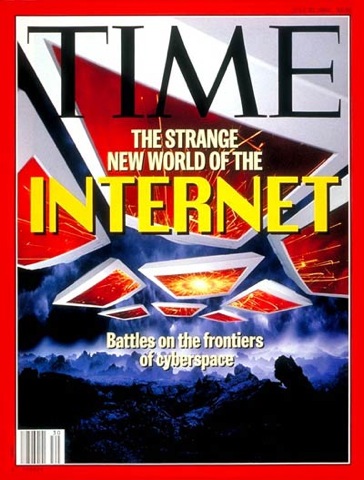
What seems most dated about the article?
Pirate of Silicon Valley - part 1 on YouTube. Great movie... tell me what you think in the comments (maybe you disagree!).
Monday, January 24, 2011
Chapter 2 slides
Should be here soon. I made it a movie because the file was too big to post on Google Docs.
Test #1 due 1-31
Intro to Mass Media
Test I (Take-home)
Rules:
1. Your main source for this test is the book, but you are free to use outside sources or our lecture. Please cite any outside sources at the end of the paper (you can choose the citation style: MLA, APA, etc.)
2. You can use fellow classmates.
3. The test must be written 100% by yourself. That means you can talk about the answers with a classmate, but when you sit down to write it has to be all yours. If it is too similar to another classmate's, I either won't take them or make both students redo it with new questions, depending on how similar they are.
Pick TWO questions to answer.
You should write about 2-3 double spaced pages for each question (4-6 pages total)
Please print and turn in at the start of class Monday, Jan 31.
1. (Chapter 1) Please define and discuss at least four functions of the mass media. What dysfunctions are associated with each function? Use examples if you can.
2. (Chapter 1) What is convergence, and what types of convergence are happening now? Be sure to discuss some of the positive and negative aspects of this phenomenon.
3. (Chapter 1 & 2) What does it mean to be "media literate," and why is it important? What are some key areas of understanding one should have to be considered media literate?
4. (Chapter 2) You are the editor of the campus newspaper. One of your reporters has just written a series of articles describing apparent health-code violations in a popular off-campus restaurant. This particular restaurant regularly buys full-page ads in your paper. After you run the first story in the series, the restaurant owner calls and threatens to cancel all her ads unless you stop printing the series. The ads are a significant part of your paper's budget.
What is the ethical dilemma here? Use the ethical principals on pp. 53-55 to analyze the situation and pick the best course of action.
Friday, January 21, 2011
Reaction Paper #1 due 1-28
Here is the article.
(Let me know if it tries to make you sign in or if you have any problem clicking on the link, sometimes the NY Times has issues)
I'd like you to
1. Summarize the concerns researchers have when it comes to all these digital distractions for kids.
2. Give me your thoughts -- do you tend to agree or think the concerns are overblown?
3. What can/should be done about these digital distractions? If there should be limitations, what age would you lift them?
Length: ~700 words. (At least a page single spaced)
Again, you can print it and hand it in on Friday in class or email it to me by the end of the day (midnight) on Friday 1/28.
Edit: if it is making you register, you can try clearing your browser cache/history.
(Let me know if it tries to make you sign in or if you have any problem clicking on the link, sometimes the NY Times has issues)
I'd like you to
1. Summarize the concerns researchers have when it comes to all these digital distractions for kids.
2. Give me your thoughts -- do you tend to agree or think the concerns are overblown?
3. What can/should be done about these digital distractions? If there should be limitations, what age would you lift them?
Length: ~700 words. (At least a page single spaced)
Again, you can print it and hand it in on Friday in class or email it to me by the end of the day (midnight) on Friday 1/28.
Edit: if it is making you register, you can try clearing your browser cache/history.
Monday, January 17, 2011
pre-Reaction paper due Friday 1-21
Hey folks,
I'll send the first real paper out on Friday the 21st, but in the meantime here is a warm-up paper for me to get to know you guys and what your interests are in the mass media.
Please tell me what your interests are in the mass media: do you enjoy books, the Internet, video games, movies, TV, radio, music, or all of the above? Do you have any favorite websites?
What do you look forward to learning about in the mass media? What don't you look forward to learning about?
Any other concerns, questions, or ideas for me regarding class?
Worth 5 points.
The paper should be about a page single-spaced. You can hand it in Friday or email it to me.
I'll send the first real paper out on Friday the 21st, but in the meantime here is a warm-up paper for me to get to know you guys and what your interests are in the mass media.
Please tell me what your interests are in the mass media: do you enjoy books, the Internet, video games, movies, TV, radio, music, or all of the above? Do you have any favorite websites?
What do you look forward to learning about in the mass media? What don't you look forward to learning about?
Any other concerns, questions, or ideas for me regarding class?
Worth 5 points.
The paper should be about a page single-spaced. You can hand it in Friday or email it to me.
Book summary E.C.
Based on the book you found at the library and brought the second day:
1. Read the book.
2. Write a 700-word summary. What interesting points does the author make? What seems the most relevant to class? Do you disagree with any assertions?
3. Hand it in/email me your paper before March 1st.
Earn up to 10 points extra credit (I know it's early for E.C... but hey, might be smart to take advantage of it).
P.S. you can choose a new book if you grabbed a bland one (or if you didn't get a chance to pick one up originally).
1. Read the book.
2. Write a 700-word summary. What interesting points does the author make? What seems the most relevant to class? Do you disagree with any assertions?
3. Hand it in/email me your paper before March 1st.
Earn up to 10 points extra credit (I know it's early for E.C... but hey, might be smart to take advantage of it).
P.S. you can choose a new book if you grabbed a bland one (or if you didn't get a chance to pick one up originally).
Sunday, January 9, 2011
Intro to Mass Media
JOU 110
Syllabus • Spring 2011
Ankeny Campus
Instructor : Andy Langager
Email: andylangager@gmail.com
Cell phone: 319-290-8229
Office: Building 3W, Room 2 (Office inside on the left)
Office Hours: By appointment
Class website: http://mass-media-class.blogspot.com
This class meets MWF 9:05-10 a.m. • Building 2 Room 13
Course Description:
We have "Freedom of the Press," but have you ever considered what isn't allowed to be printed in the newspaper or broadcast on the radio? Have you thought about how the invention of television impacted the film industry? What about the content of your Facebook profile as a concern when you're applying for a job?
We can't escape the mass media in our daily lives. TV, radio, the Internet, film, music, magazines and books surround us everyday. To be an effective participant in our democratic society, it is essential to be able to think critically about the mass media and understand its history, laws, ethics, and effects.
I want you be engaged with this class: participating in class discussions and reaction papers will challenge your critical thinking, while the tests will demonstrate your understanding of its history, laws, ethics and effects.
Required Text:
Pavlik, John V. and McIntosh, Shawn. Converging Media. Second Ed.
Email: Regular access to email is a strong requirement for this course. Assignments, study guides, and other class info will be sent via email.
Attendance policy: Attendance is an important part of succeeding in this course. Much of what we do will involve class discussion. I do not take regular attendance, but we will have short quizzes from time to time -- points that you can only earn if you are in class.
Reaction Papers: We'll have 10 reaction papers assigned throughout the semester. Each will be worth 10 points. You'll have a week to do them once I send them out. Try not to miss any; the points quickly add up to a large part of your grade.
Papers will be about one full page single spaced, based on a short reading assignment or theme. You can email your paper before class on Fridays or hand it on on paper during class.
Research Paper: We will have a five page research paper on the subject of your choice that will be due toward the end of the semester. More info as we get closer.
Tests: There will be five tests (including the final). We will have two essay tests and three that are multiple choice, true false, short answer and essay.
Academic dishonesty: Cheating and plagiarism will be dealt with according to DMACC's official policies. Always cite your sources, never lift other sentences word for word without using quotes. Attribute any ideas or facts that aren't common knowledge to the original author. If you're not sure, ask for help.
Conferences: Feel free to schedule a conference with me anytime. Email is a great way to reach me; I check it often. I may not be on campus when you are (outside of this class), so scheduling a meeting is the best way to get a hold of me. My office is in Room 2 (The Chronicle room), building 3W in Ankeny.
Grading:
Tests: 5 x 50 points = 250 points total
Reaction papers: 10 papers x 10 points each = 100 points
Research paper: 50 points
Quizzes and participation: 50 points
= 450 total points
Grading scale:
94-100% A
90-93 A-
87-89 B+
84-86 B
80-83 B-
77-79 C+
74-76 C
70-73 C-
67-69 D+
64-66 D
60-63 D-
59 and lower F
"A" work: Deadlines met regularly for assignments; student has gone above and beyond to demonstrate he or she understands the concepts of the assignment. Shows time and effort put into every assignment. Communicates with instructor about missed classes. Overall work is excellent.
"B" work: Deadlines met for nearly every assignment; student has show he or she has a strong understanding of the concepts of the assignments. The basic requirements of the assignments are fulfilled with good, solid work. Overall work is above average.
"C" work: Most deadlines met, but some missed. Not all assignments fulfilled to specifications. Student shows some understanding for the concepts at hand, but some of the work could have benefited from more time or effort put into it. Sometimes communicates with instructor about missed classes. Overall work is average.
"D" work: Deadlines missed regularly. More than one or two assignments missed. Student does not fully demonstrate an understanding of the concepts. Rarely communicates with instructor. Not much effort put into work. Overall work is below average.
"F" work: Deadlines missed regularly. Assignments left incomplete. Student shows distinct lack of effort towards the class. No demonstration of learning the concepts at hand. Almost no communication with instructor. Overall work is far below average.
Staying in touch with the media: Since this class is all about the mass media, I encourage you to stay current, especially with news (whether it be TV, Internet, or radio). Keep in mind anything interesting going on in the media to discuss in class (or email me a link and I'll put it on our class blog!)
Late assignments & Tests
• Reaction papers: will take papers up to 5 days late with no penalty. Papers won't be accepted after 5 days (talk to me if you need an extension on an assignment)
• Tests: You can make up a test for full credit with a note from a doctor (or pre-arrangement with me) otherwise late tests will be marked off 20% (you'll have 7 days to make it up)
• Research paper: 20% off for late papers
Classroom conduct: It goes without saying to treat fellow classmates (as well as your instructor!) with respect.
Yes, I (and your classmates) can see when you are texting. Please turn cell phones to vibrate and leave the class without disruption if you need to make a call, get a drink, etc. Please don't read newspapers, work on other assignments, or have side conversations during class time. Also, please come to class on time.
DMACC websites
Admissions & registration http://www.dmacc.edu/potienti.asp
WebCT http://webct.dmacc.edu/webct/public/home.pl
Student handbook http://www.dmacc.edu/handbook/welcome.asp
Add/drop dates http://www.dmacc.edu/registration/add_drop.asp
Refund policy http://www.dmacc.edu/refund.asp
Library (Building 6 Ankeny) http://www.library.dmacc.edu/
Academic Achievement Center: Building 6. MW 9 a.m. - 4 p.m. / TR 9 a.m. - 6 p.m.
For an appointment call 515-633-2472
Support services
"It is the policy of DMACC to accommodate students with disabilities. Any student with a documented disability who requires reasonable accommodation should contact the special needs coordinator at 515-964-6850 voice or 515-964-6810 TTY." Also, http://www.dmacc.edu/student_services/disabilities.asp
Important: For each reading assignment listed, you should have it completed for the day it is listed.
----------------------------------------------------------------------------
Monday - January 10
Introduction
Wednesday - January 12
Syllabus
Friday - January 14
Part 1: The Changing Media Landscape
Chapter 1 MASS COMMUNICATION AND ITS DIGITAL TRANSFORMATION
----------------------------------------------------------------------------
Monday - January 17 - NO CLASS (MLK Day)
Wednesday - January 19
Chapter 1 continued
Friday - January 21
Chapter 2 MEDIA LITERACY AND THEMES
----------------------------------------------------------------------------
Monday - January 24
Chapter 2 continued
(Take-home Essay Test)
Wednesday - January 26
Part 2: Mass-Communication Formats
Chapter 3 DIGITAL MEDIA: ONLINE AND UBIQUITOUS
Friday - January 28
Chapter 3 continued
----------------------------------------------------------------------------
Monday - January 31
Chapter 4 PRINT MEDIA: BOOKS, NEWSPAPERS, MAGAZINES
Wednesday - February 2
Chapter 4 continued
Friday - February 4
Chapter 5 AUDIO MEDIA: MUSIC RECORDINGS, RADIO
----------------------------------------------------------------------------
Monday - February 7
Chapter 5 continued
Wednesday - February 9
Chapter 6 VISUAL MEDIA: MOVIES AND TELEVISION
Friday - February 11
Chapter 6 continued
----------------------------------------------------------------------------
Monday - February 14
Chapter 6 continued
Wednesday - February 16
In-Class Test (Test #2)
Friday - February 18 - NO CLASS (College closed)
----------------------------------------------------------------------------
Monday - February 21
Part 3 How Digital Media Are Changing Our World
Chapter 7 INFORMATION OVERLOAD, USABILITY, AND INTERACTIVE MEDIA
Wednesday - February 23
Chapter 7 continued
Friday - February 25
Chapter 8 NETWORKS AND DISTRIBUTING DIGIAL CONTENT
----------------------------------------------------------------------------
Monday - February 28
Chapter 8 continued
Wednesday - March 2
Chapter 9 SOCIAL MEDIA AND WEB 2.0
Friday - March 4
Take-home Test (Test #3)
----------------------------------------------------------------------------
Monday - March 7 (Semester halfway point)
Part 4: Media Perspectives
Chapter 10 JOURNALISM
Wednesday - March 9
Chapter 10 continued
Friday - March 11
Chapter 10 continued
----------------------------------------------------------------------------
March 14-20: SPRING BREAK!
----------------------------------------------------------------------------
Monday - March 21
Chapter 11 ENTERTAINMENT
Lecture: Video Games
Wednesday - March 23
Video games, continued
Friday - March 25
Chapter 12 ADVERTISING AND PUBLIC RELATIONS
----------------------------------------------------------------------------
Monday - March 28
Chapter 12 continued
Wednesday - March 30
Chapter 12 continued
Friday - April 1
Test #4
----------------------------------------------------------------------------
Monday - April 4
Part 5: Media and Society
Chapter 13 MEDIA THEORY AND RESEARCH
Wednesday - April 6
Chapter 13 continued
Friday - April 8
Ethics Lecture
----------------------------------------------------------------------------
Monday - April 11
Chapter 14 COMMUNICATION LAW AND REGULATION IN THE DIGITAL AGE
Wednesday - April 13
Chapter 14 continued
Friday - April 15
Chapter 14 continued
----------------------------------------------------------------------------
Monday - April 18
CHAPTER 15 MASS COMMUNICATION AND POLITICS IN THE DIGITAL AGE
Wednesday - April 20
Chapter 15 continued
Friday - April 22
Lecture: The Global Village
----------------------------------------------------------------------------
Monday - April 25
Global Village continued
Wednesday - April 27
Review/make-up day
Friday - April 29
No class
----------------------------------------------------------------------------
Final Exam: Wednesday - May 4 (Chapters 13, 14, 15, Ethics & Global Village Lecture)
9:15 a.m. - 11:15 a.m.
Disclaimer: "This syllabus is representative of materials that will be covered in this class; it is not a contract between the student and the institution. It is subject o change without notice. Any potential exceptions to stated policies and requirements would be addressed on an individual basis, and only for reasons that meet specific requirements. If you have an problems related to this class, please feel free to discuss them with me."
Subscribe to:
Posts (Atom)